updates
Haven Demo Mission Complete: Successful Deorbit Validates Path to Haven-1
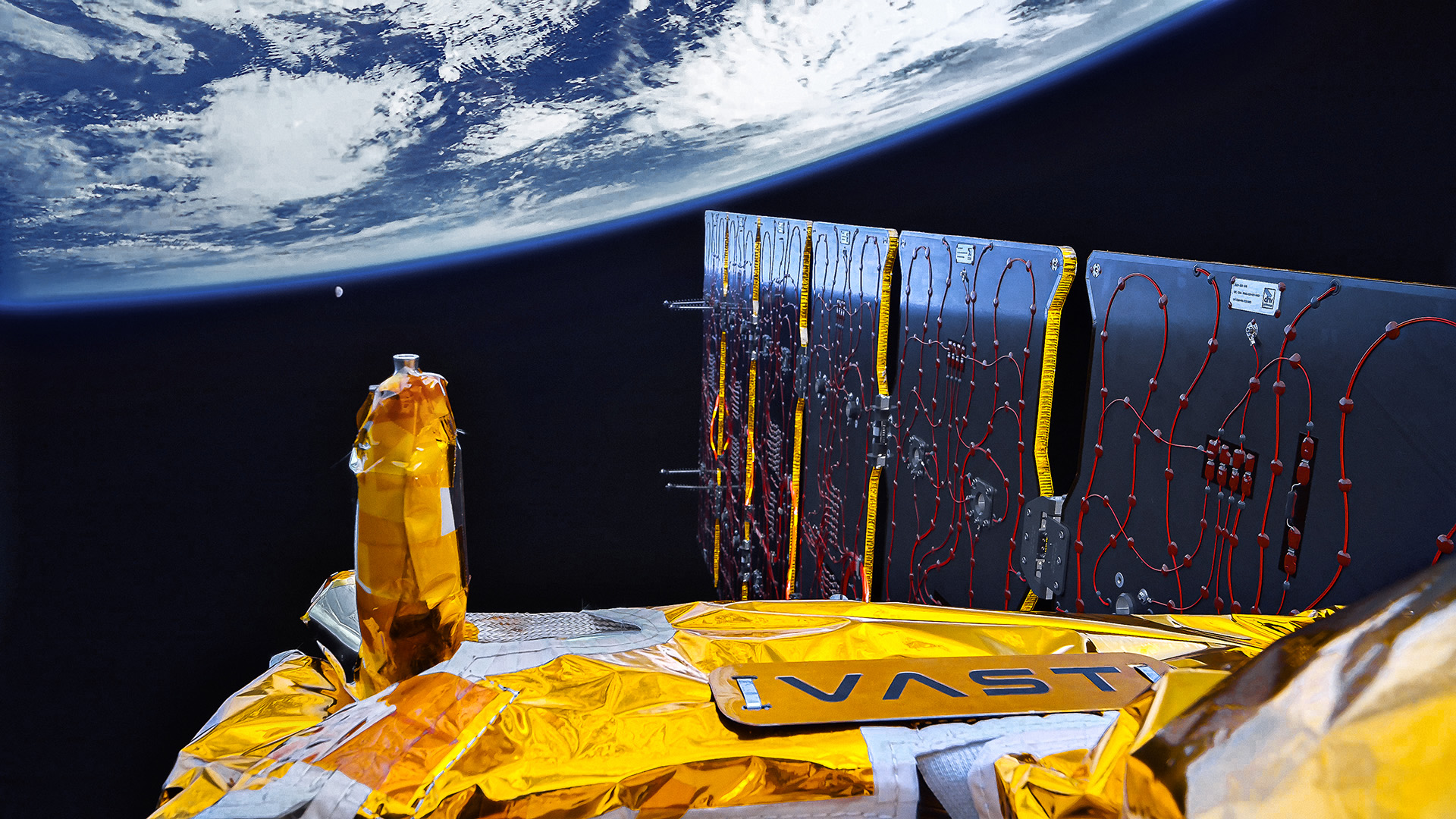
On February 4, 2026, Vast Mission Control Center in Long Beach, California confirmed we had successfully performed a controlled deorbit of Haven Demo, our in-space testbed for Haven-1 and future station technologies.
Over its three-month mission, Haven Demo successfully completed a total of 49 test objectives and remained power positive for the duration of its flight, even enduring historical spikes in volatile space weather. Vast is now the first operational commercial space station company to design, manufacture, fly, operate, and deorbit a spacecraft.
Learnings from launch
Following launch on November 2, 2025 at 1:09 a.m. ET (06:09 UTC) on the Bandwagon-4 rideshare mission from Cape Canaveral, Haven Demo successfully separated from the rocket and began orbiting independently. Prior to launch, its systems underwent rigorous environmental and qualification testing to validate models, identify issues, and ensure mission readiness.
.png)
Haven Demo deployed its solar panels four minutes after separation and became power positive on November 2, 2025 at 1:24am ET (06:24 UTC). Mission operations made first contact with Haven Demo 23 minutes later and confirmed that all systems were online. Shortly thereafter, the spacecraft transmitted video of its solar array deployment.
Learnings from on-orbit operations
While on orbit, Vast mission operations tested critical station technologies, systems, components, and processes that enable us to derisk future missions, including: guidance, navigation, and control (GNC) hardware and algorithms, avionics compute, networking, and power distribution, solar arrays, radio frequency (RF) hardware and communications, cameras, thermal control, in-space propulsion, and flight software.
While all of these systems were subject to rigorous testing prior to flight, space-to-ground communication architecture can only be truly tested once in orbit. Shortly after separation from the rocket, our mission control team was able to verify two-way communication with Haven Demo over multiple communication pathways.
“Haven Demo gave us exactly what we needed: real flight data,” said Jim Martz, Senior Vice President of Engineering at Vast. “You can model propulsion, radiation effects, and navigation on the ground, but until you operate in orbit, you don’t truly know how your systems perform.”

Long before launch, the team used multiple testing configurations to assess how the spacecraft would perform in flight. By the time the spacecraft made it to orbit, we had a solid understanding of how it would respond to numerous scenarios. The team utilized a ground test simulator (GTsim) to run thousands of mission simulations with varying parameters to prove resilience, a software-in-the-loop (SITL) asset to test flight software on a virtual spacecraft, and a hardware-in-the-loop (HITL) asset to test actual flight hardware and software in a simulation environment prior to launch.
Throughout the mission, the team was able to validate and refine models with real flight data using the Haven Demo HITL, enabling creation of an even higher-fidelity HITL test asset to further derisk the Haven-1 mission.
Throughout the mission, we also used these models to test software updates on the ground before uplinking them to the spacecraft. For example, the first version of the software on Haven Demo enabled it to autonomously point towards the sun for optimal power generation, while subsequent software updates gave us additional pointing options and more precise attitude control.
Other unique findings include:
- On-orbit radiation effects matched our ground predictions and testing, confirming our radiation mitigation systems worked as designed.
- On-orbit GPS data occasionally showed unexpected behavior, likely due to radio interference over conflict regions. Software updates allowed the navigation system to identify and filter out unreliable position signals.
- Propellant performance was modeled on the ground, but Haven Demo provided flight learnings that will inform how we manage propellant and plan operations for Haven-1.
- Radio frequency (RF) communication systems were validated on Haven Demo with real orbital data, utilizing the same Geostationary Earth Orbit (GEO) and ground assets that will connect future crew to mission control.
From test burns to splashdown
In January 2026, our mission control operations and propulsion teams began conducting test burns of the Impulse Space Saiph thrusters, validating our propellant conditioning operations and anchoring our thruster performance to ground test vacuum chamber data. Following successful test burns, the team initiated Haven Demo's first perigee-lowering maneuver that lasted roughly 14 minutes, and lowered the spacecraft’s altitude by 170 km.
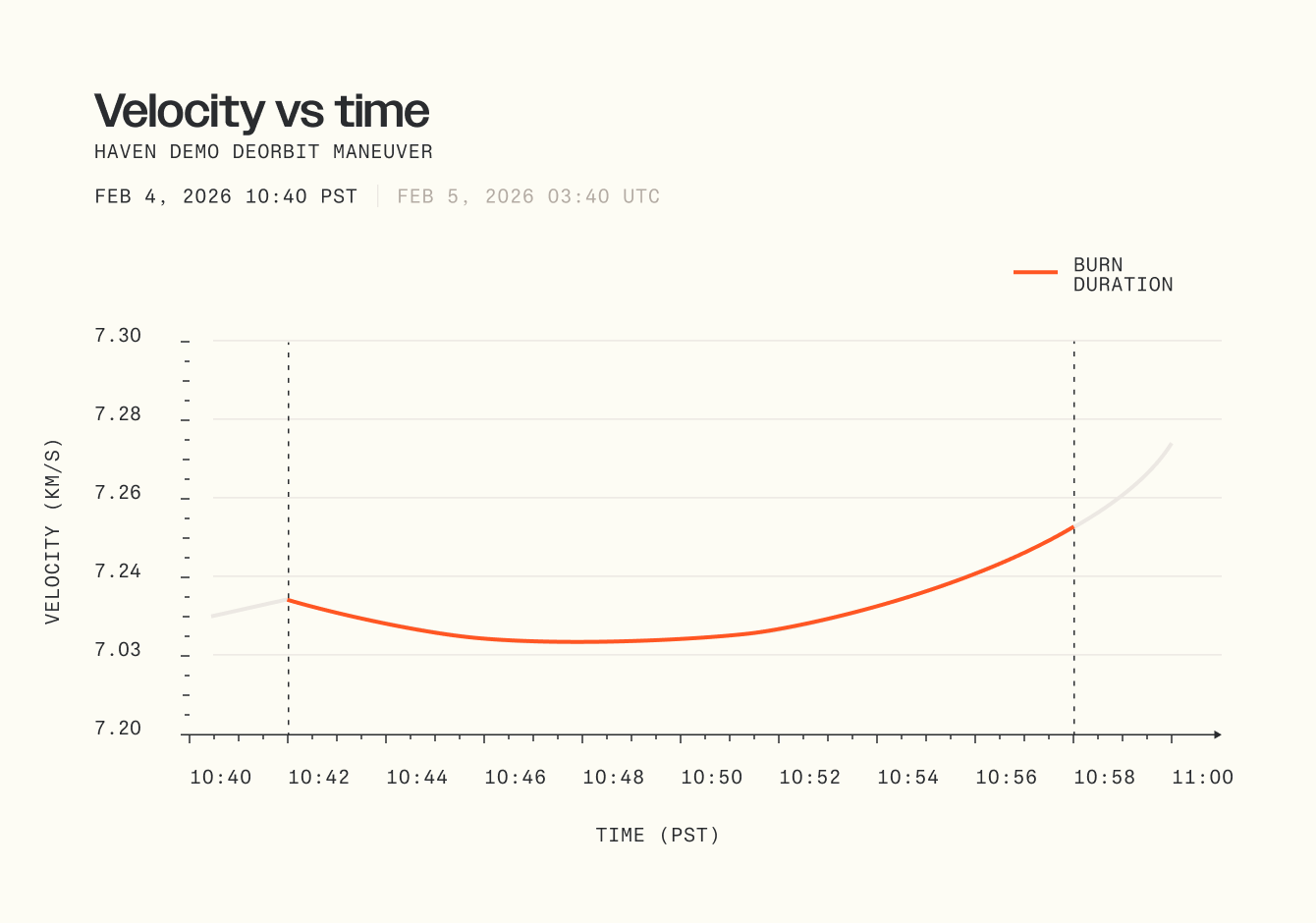
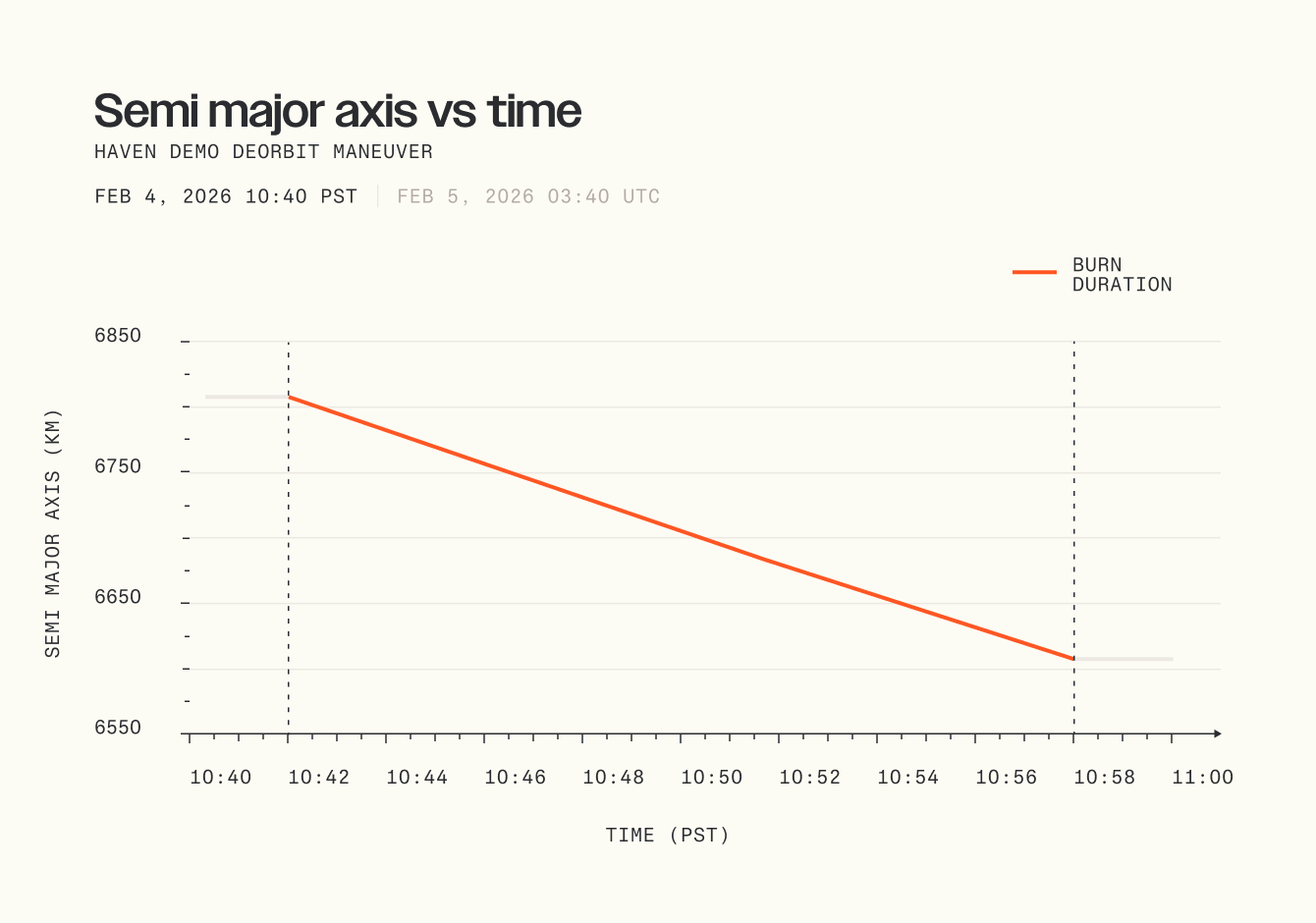
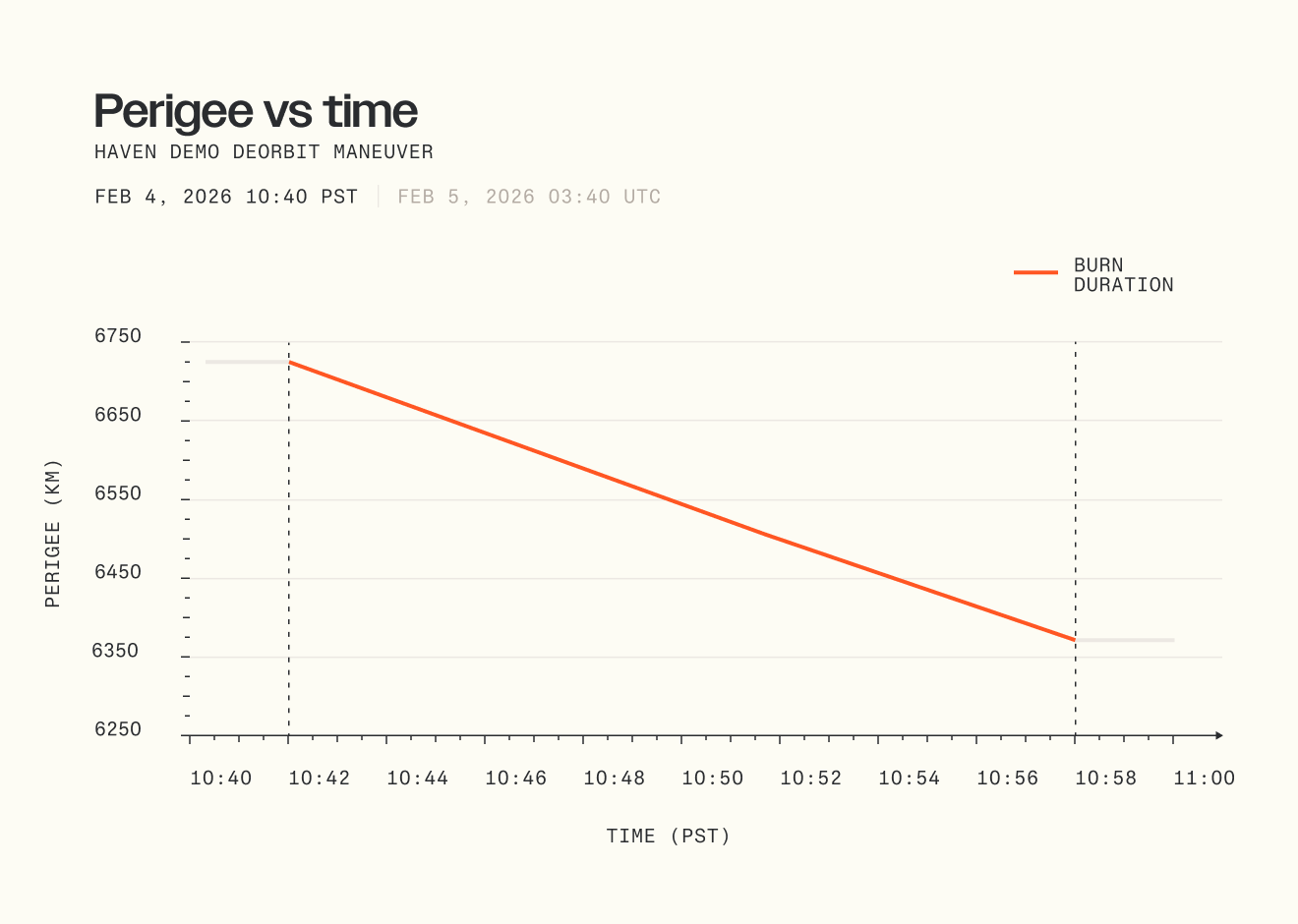
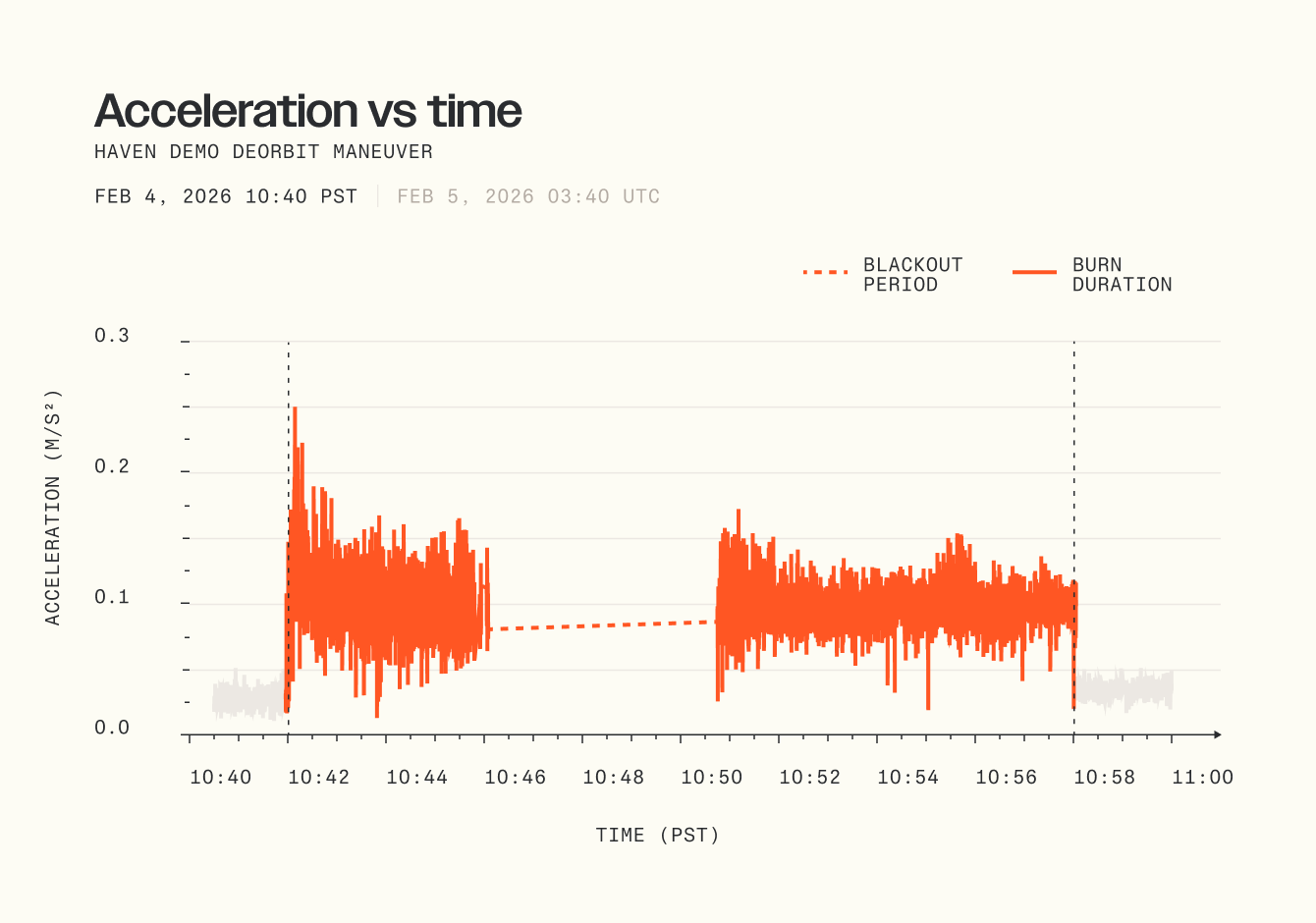
On February 4, 2026 at 7:40 PM PST (February 5, 2026, 03:40 UTC), the team began the final deorbit sequence, executing the terminal deorbit burn that brought Haven Demo precisely and safely towards its designated splashdown area in the South Pacific Ocean. We coordinated closely with NASA, aviation, and maritime safety authorities to ensure a controlled and responsible reentry consistent with our regulatory authorizations for the mission.
The controlled deorbit of Haven Demo instills confidence that Vast has matured the required systems to perform a safe, controlled deorbit of future modules. Safe deorbit capability is fundamental to maintaining a sustainable presence in low-Earth orbit (LEO) and safeguarding human activity in space. The team’s precise and disciplined execution of the satellite’s deorbit underscores Vast’s commitment to responsible space operations and our technical expertise in performing high-accuracy, controlled deorbit maneuvers.

Our stepping-stone approach to a continuous human presence in space
Haven Demo is the first step in our hardware-rich, iterative approach toward building next-generation space stations to ensure America’s continuous human presence in space. Vast undertakes a stepping stone approach to building and launching modules, a process we believe makes our stations safer, reduces technical risk, proves on-orbit capabilities, and lowers costs.
With the completion of the Haven Demo mission, we are now roughly 40% of the way to delivering a continuously crewed space station. Next year, in Q1 of 2027, our Haven-1 module will be flight-ready. On this crewed mission, the pressurized module will also have a closed-loop life support system, spacecraft docking, and a microgravity laboratory.
Haven-1 is on-schedule to be the world’s first commercial space station. Last year, the flight primary structure passed full-scale pressure and static load testing and is now undergoing Phase 1 integration in the cleanroom at our Long Beach headquarters.
For Haven-1’s inaugural mission, four crew members will embark on four two-week missions aboard the spacecraft. The mission, like all subsequent Haven missions, will include opportunities to conduct advanced science, research, and in-space manufacturing.
The road to 100% continuous crew capability
Haven-2 will build upon the legacy of the ISS with continuous crew capability to serve NASA and the growing LEO economy. Starting in 2028, we will begin launching Haven-2 modules every six months, reaching a four-module station capable of supporting continuous crew by the end of 2030.
By building, testing, flying, deorbiting, and improving demonstration hardware, Vast continues to prove we are capable of developing next-generation space stations for a continuous human presence in space.
“This mission was about more than a single spacecraft. It was also about building a world-class team and demonstrating that Vast can design, build, operate, and safely deorbit space infrastructure,” said Martz. “That end-to-end capability is what enables Haven-1, and ultimately a permanent human presence in LEO.”
.jpg)
